Pillar 01 · Ticket triage

Every ticket arrives with a hypothesis.

When your team opens a P1, the root cause, the matching KB, and the first three execution steps are already there. They override what's wrong and trust what's right. The judgment is still theirs — the assembly isn't.
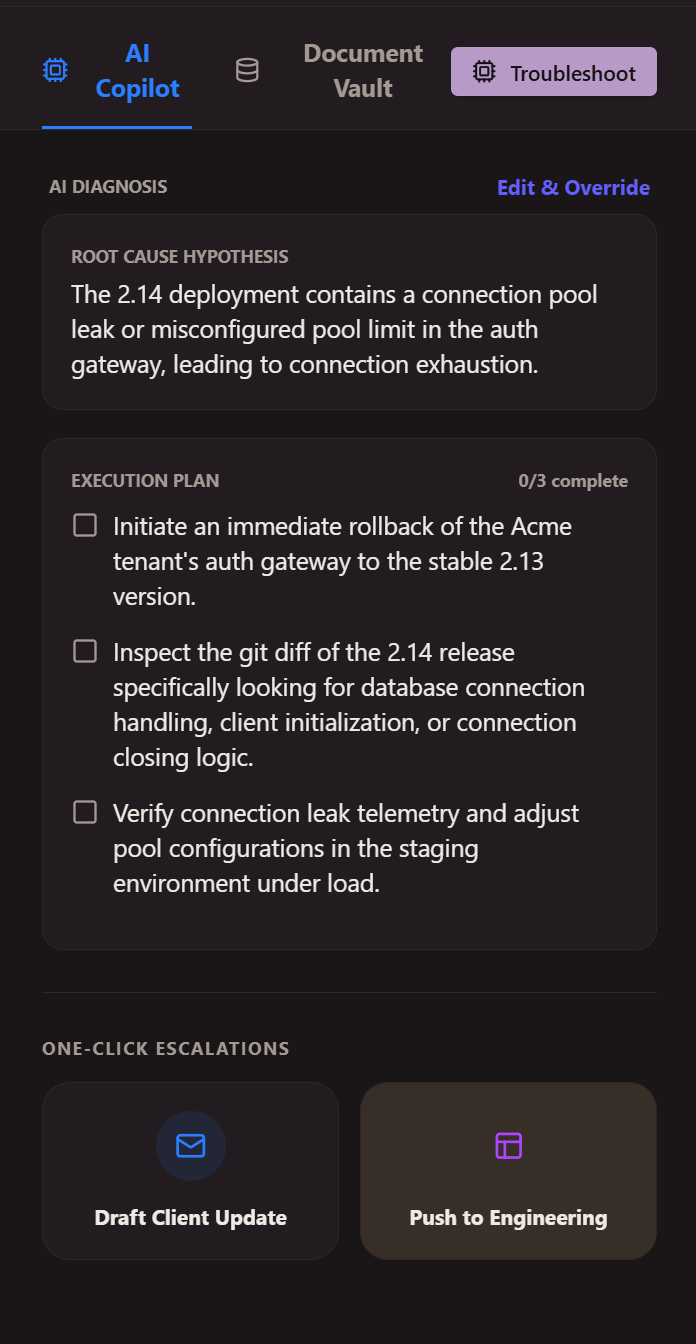
Quantesic customer app ticket triage screen showing an inbox ticket with AI-assisted context and next steps.
The reality

Queues used to scale by adding people. They can't anymore.

The smartest support engineer on your team still loses ten minutes per ticket to context assembly. The next-smartest loses more. Across a quarter, that's a headcount worth of hours spent doing what a system should be doing.

Worse: the judgment work — the part your team is actually good at — comes after the slog. They're tired by the time the real decision shows up.

What it does

What ticket triage actually does.

CAPABILITY 01

Root-cause hypothesis on every inbound.

Quantesic reads the ticket against your knowledge base, prior tickets, and product telemetry, and returns a hypothesis with a confidence score. Your team overrides what's wrong and trusts what's right.

CAPABILITY 02

KB matching that's actually accurate.

Similarity-scored against your real KB — not a generic vector index. When there's no match, it says so. Your team stops scrolling through ten near-misses to find the one that fits.

CAPABILITY 03

Execution plan with the next three steps.

Specific, account-aware, with the linked dashboards and previous resolutions attached. The first ten minutes of every ticket are already done before a human reads it.

CAPABILITY 04

One-click escalation when triage hits a wall.

Hypothesis, evidence, and prior context handed to engineering as a complete case — not a Slack message asking them to dig.

What changes

When triage stops being the first ten minutes.

The work shifts from assembly to judgment. The judgment is the part your team is good at.

Time-to-resolution drops without losing judgment.

Your team still makes the call. They just don't spend the first ten minutes assembling context. The judgment is theirs. The assembly isn't.

KB-deflection actually works.

Because the match is real and account-aware, customers get answers, not generic links. Self-serve goes up. Re-opens go down.

Escalations arrive credible.

Engineering trusts what comes from your team because it ships with the evidence already attached. Less back-and-forth. More fixes.

Who this is for

Head of Support and CX Ops, first. CS managers running escalations, second.

Pairs with

Built to work as one layer.

Each pillar stands on its own. They get stronger together.

See it before your next renewal call.

A 30-minute walkthrough of the four pillars, with the person who built it.